Erin M Diericx and her mom
Peace be with you!
There is nothing more intimidating than being interrogated by your mother. Somehow mothers always know the truth, even before and in the midst of questioning you.[i] My mother always catches me in my lies right away. For example, when I try to change plans with her so I can go out with friends, she says, “Just tell me you want to go out with your friends instead of coming here for dinner,” or “Fine, just go out with your friends. I have not seen you in two weeks, but go out with them.” Mothers’ sixth sense allows them to know their children’s needs, wants, and behaviors even before they can vocalize them.
Jesus knows his disciples’ needs, wants, and behaviors like a parent does. In John 21:1-19, Jesus appears to seven of his disciples by the Sea of Tiberias for a third and final time after his resurrection. Presumably Peter and the other disciples have gone back to their previous occupation after Jesus dies. One night the seven disciples go fishing and catch no fish (John 21:3). At dawn, the disciples see a man on the shore who tells them to put their net on the other side of the boat, and when they do, they caught so many that they cannot bring the net in (John 21:5-6).
Although the disciples do not recognize the man as Jesus, but curiously, they do as he suggests—casting the net on the right side of the boat (John 21:6). A few scholars suggest the disciples may have been desperate to catch fish, or maybe they just loved fishing. I would like to think that their subconscious realizes the  man is Jesus before they can register the thought. The disciples are loyal and obedient to Jesus, even when they do not realize it. Jesus is also loyal to his disciples by coming to them between giving them the Holy Spirit and the pouring out of the Spirit on the whole church at Pentecost. He reassures the disciples that he remembers his promise to enable them to spread the good news. Jesus never leaves the disciples’ side, even after his death and resurrection. Jesus does everything in his power to help the disciples to fulfill his commission to them to spread the good news and to share God’s love with the world.[ii]
Then the beloved disciple realizes the man is the resurrected Lord and tells Peter (John 21:7). Peter is overwhelmingly excited to see Jesus; he jumps overboard, and swims to shore, leaving the other disciples bring the boat and fish to shore (John 21:7-8). When the disciples are on shore, Jesus asks for some fish to  put over the fire for breakfast and breaks bread, which might remind them of the feeding of the five thousand and the Last Supper. The fact Jesus already has fish on the fire demonstrates how he always has our backs. Jesus always finds a way to enable us to spread the good news and to share God’s love in the world. Jesus will always give us the tools we need to do God’s work. Yet by asking for some fish the disciples caught, Jesus also demonstrates how he finds ways to use our unique gifts in order to do his work in the world. Jesus uses our gifts for his glory.[iii]
Then the breakfast conversation gets serious: Jesus interrogates Peter, who denied knowing him three times during Jesus’s trial. Jesus knows Peter denied knowing him three times, just as he predicted (John 13:38; 18:17, 25-27). Jesus asks Peter three times if he loves him. In Greek, there are three different words for love, which are eros (romantic love, a self-serving love), philos (love between friends), and agape (self-giving love). When Jesus questions Peter and Peter replies, the two of them use different words for love.[iv]
The first and second time Jesus asks, “Peter, do you love (agapē) me?” and Peter answers, “Of course, Lord. I love (philos) you, you know that” (see John 21:15-16). Jesus wants to know if Peter deeply loves him. The third time Jesus asks, “Peter, do you love (philos) me?” and Peter answers, “Of course, Lord, I love (philos) you; you know everything” (see John 21:17).[v] In other places of the Gospel of John, agapē is used to describe divine love (John 3:19; 12:43), while philos describes human love.[vi] Jesus understands Peter cannot love him as deeply as he loves him. Jesus knows Peter loves him, even before the interrogation, yet these questions make Peter uncomfortable. He knows the Lord knows his heart, so why does he keep asking? What point is Jesus trying to make? Jesus’s questions reverse Peter’s three denials of knowing Jesus by restoring his relationship with the Triune God. The interrogation demonstrates the power of the resurrection and God’s forgiveness, grace, and love. There is nothing that can separate us from the love of Christ.
Now Jesus gives Peter a commission: “Feed my lambs. Tend my sheep. Feed my sheep” (see John 21:15-17 NRSV). Saying he loves the Lord is not enough; now Jesus calls upon Peter to put his words into action. Instead of going back to his old life, Jesus instructs Peter to go out into the world and share the good news with anyone and everyone who will listen. Jesus is commissioning Peter to go beyond his small fishing village—his comfort zone—and share his testimony with the world. Following Jesus means facing and going to dangerous situations. It means suffering on behalf of others in order to express God’s love to those who do not know him. It means befriending those who may make you feel uncomfortable. It means welcoming the homeless, the poor, the disfigured, the disabled, and others who are less fortunate to God’s table.
It is not enough to say that you love (philos) the Lord; you also need to demonstrate your love for the Lord  through your actions toward others. Your commission is to go out into the world in order to feed and tend to God’s lost sheep. It requires you to go beyond your community by stepping out of your comfort zone in order to bring others into a relationship with God the Father, God the Son, and God the Holy Spirit. If you see someone who is hungry, give her food. If you see someone who is homeless, give her shelter. If you see someone who is hurting, tend to his wounds. If you see someone who is lonely, welcome him into your community. By doing so, you will nourish and nurture a community centered around God’s love—a selfless love that breaks the barriers of time and space.
Thanks be to God!
Dear Heavenly Father, thank you for showing us the power of the resurrection. Push us outside of our comfort zones to nourish and nurture our communities. Make your love burn in our hearts, so we are inspired to share your love, forgiveness, and grace with others. Thank you for forgiving us when we fall. Amen.
[ii] Andreas J. Köstenberger, John, vol. 4 of BECNT (Grand Rapids: Baker Academic, 2004), 590-591.
[iii] Ibid., 592.
[iv] Frank L. Crouch, “Commentary on John 21:1-19,” Working Preacher, http://www.workingpreacher.org/preaching.aspx?commentary_id=569.
[v] Ibid.
[vi] Andreas J. Köstenberger, John, 596.

 to build meaningful and lasting relationships. We struggle to create authentic communities that would have people who lift up our strengths and lament with us in our brokenness. We struggle to connect with a seemingly distant and unseen Lord.
 distance between the situation and themselves. Others turn to drugs or alcohol to escape reality, while others may just deny [whatever “it” is] ever happened. The disciples are hiding until they can figure out their next step.
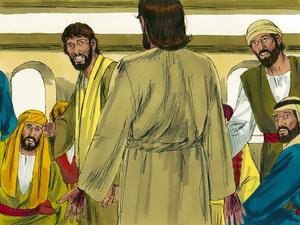
 finger here and see my hands. Reach out your hand and put it in my side. Do not doubt but believe.” Then Thomas says, “My Lord and my God!” (John 20:27-28 NRSV). Thomas gets to see Jesus’s hands, feet, and side where he was nailed to the cross and stabbed. He gets up close and personal and sees Jesus’s wounds, and therefore, he believes.
 Lord. You submerge yourself in your brokenness—depression, anxiety, post-traumatic stress disorder, physical limitations or [whatever “it” is], but then you realize God loves you, despite your brokenness, and you turn back to the Lord. The power of the resurrection is that Jesus falls aside us, and he picks us up time after time again!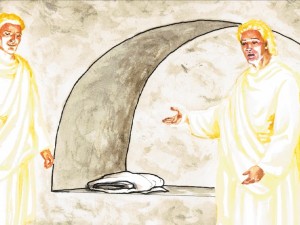



 Mary Magdalene, Joanna, and Mary mother of James, as noted in Luke 24:10) follow Joseph to the tomb and see where he lays Jesus’s body (Luke 23:55). The women who cared for Jesus during his ministry follow him to the cross and the grave. Their devotion stands in contrast to the fearful betrayals and denials of some of the disciples.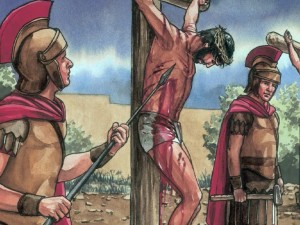

 times ahead. Family members will fight among themselves in his name. The women are weeping for the wrong reason; Jesus calls them to weep for themselves for there will be more trouble in the future.
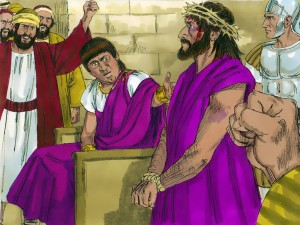

 pay their taxes, nor did he claimed to be the Messiah. Although both parties have a common goal of causing harm to Jesus, without evidence there can be no death penalty. With the help of his soldiers, Herod treats Jesus with contempt and mocks him by dressing him in an elegant robe (see Luke 23:11). This mockery points to Herod’s disregard of Jesus causing a ruckus throughout Judea and Galilee. Herod just wants one reason to have Jesus crucified and is coming up empty handed.
 scribes, leaders, and the people have not provided any new evidence to change Pilate’s mind.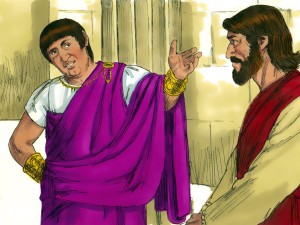

 power of God” (Luke 22:67-69 NRSV). Then the chief priests ask if he is the Son of God, and he replies, “You say I am.” (Luke 22:70).
 disrupting in Galilee for years, and now he is disrupting the peace throughout Judea (Luke 23:5). When Pilate finds out Jesus is a Galilean, he sends him to see Herod since that is his jurisdiction (Luke 23:6-7).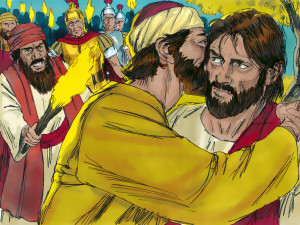

 the Father understands that he has given Jesus a heavy load and sends an angel to give him strength. As he prays, Jesus sweats huge drops like blood (Luke 22:44) as he turns to the cross.
 possible, he does not wish harm on anyone else—he even heals someone who means to cause him harm. The world may wish harm to Jesus, but he still loves his Father’s creation.
 Peter exclaims, “Man, I do not know what you are taking about.” (Luke 22:60 NRSV). Just as Jesus predicted, Peter denies knowing Jesus three times before the cock crows. The realization causes Peter to hide and weep. He has denied the one person who loved him for who he was. How could he do such a selfish thing?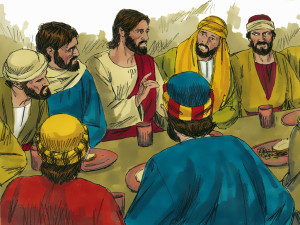

 commissioned his disciples to share this experience and these words with the world. It was not a one-time event; it is an ongoing event to remember Jesus came down into the world to rescue us from Satan and his temptations.
 Luke 22:32). Peter will not stay lost for very long, and when he finds his way back, he will be stronger. Jesus reminds his disciples that when he sent them out with nothing, they never lacked a thing (see Luke 22:35). Even when they fall away, Jesus will find and take care of them.